A camera in, a network stream out: 720p30 and 1080p30 H.264 from an AMD FPGA to VLC or ffplay on a PC.
Three IronKernel cores form the chain. IronCapture receives the MIPI CSI-2 camera, IronH264 encodes the frames, and RTLNet sends the MPEG transport stream over UDP. The chain runs on a Digilent Nexys Video (Artix-7) and a Zybo Z7-20 (Zynq-7000), with a prebuilt bitstream to try.
The image holds the whole chain with the firmware inside it. Nothing has to be built. A Digilent Nexys Video with its power supply, two micro-USB cables (PROG and UART), an Ethernet cable to a network with DHCP, and Vivado 2026.1 with its free license. The image loads into the FPGA only, so a power cycle removes it.
Program. Load rtlnet_nexys_video.bit over JTAG with the Vivado Hardware Manager or the included program.ps1. The firmware is inside the bitstream.
Connect. Open the UART port at 115200 baud, 8N1. show ip prints the address the board got from DHCP.
Play. On the PC run ffplay -fflags nobuffer udp://@:5004, or open udp://@:5004 in VLC. Let UDP port 5004 through the PC firewall.
Stream. On the console: enable, camera mode 1080p30, camera pattern all 4, encoder bitrate 8000, then stream h264 <PC address> 5004.
Measure.show stream and show encoder print picture counts, bit rate and dropped pictures. stream stop ends the stream.
H.264 Baseline streaming demo
Prebuilt
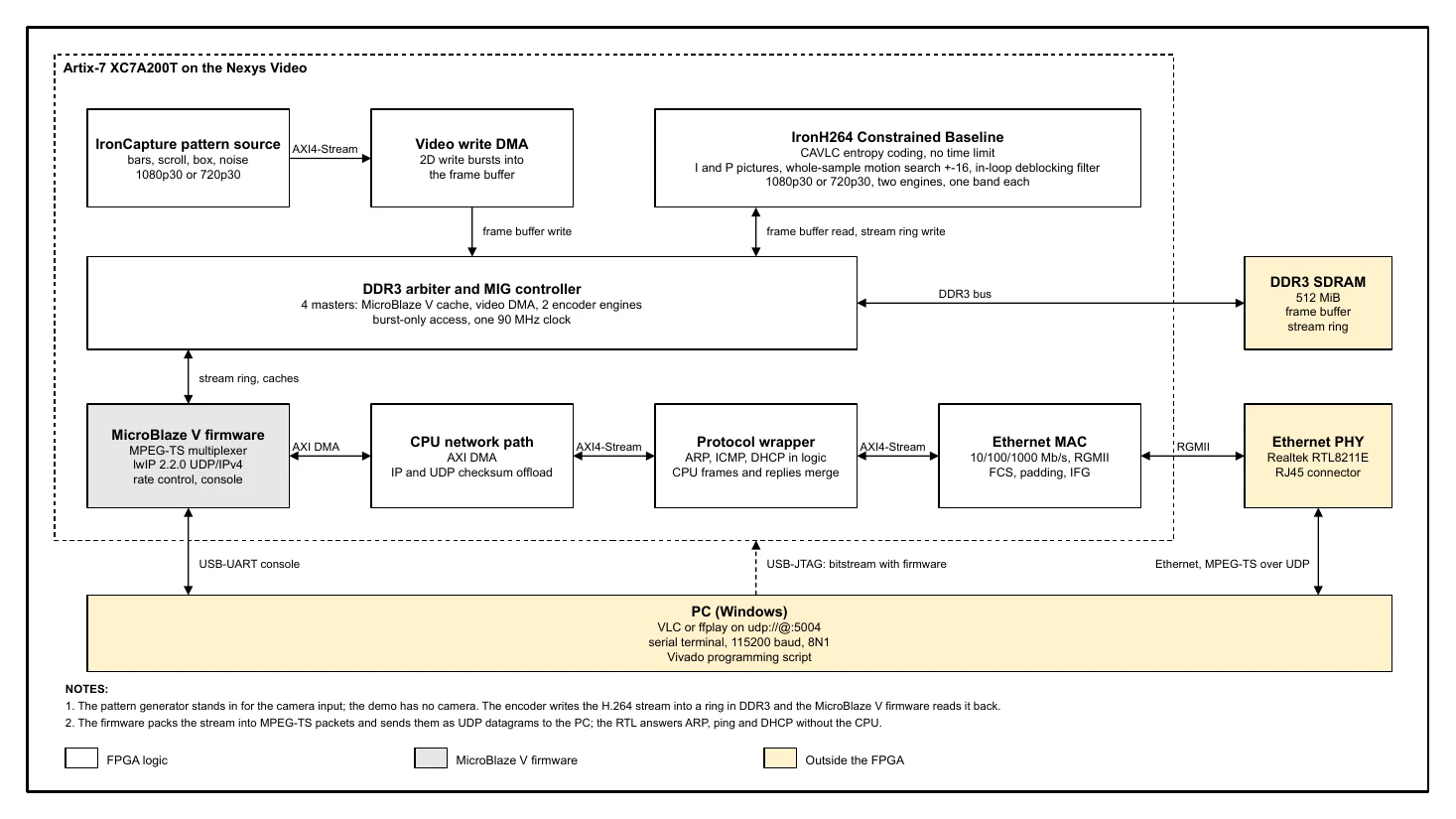
Digilent Nexys Video, Artix-7 XC7A200T. Two IronH264 engines at 90 MHz, RTLNet RGMII MAC, MPEG-TS over UDP.
720p30 and 1080p30 from the on-board pattern generator. No time limit.
Receives two-lane MIPI CSI-2 RAW10, reconstructs color and writes packed YUYV frames to DDR through an AXI4 master, with no CPU in the pixel path. It also has a pattern generator for bring-up without a camera.
Reads the YUYV frame from DDR and writes an H.264 Constrained Baseline stream (I and P pictures, CAVLC, in-loop deblocking) back to memory as indexed Annex B NAL units.
18,002 pictures in a 10-minute soak, zero dropped, minimum PSNR 44.28 dB at QP 28
1,800 of 1,800 pictures encoded and decoded, 30.00 pictures/s, zero continuity errors
Bit rate
Rate control held 7.99–8.02 Mb/s at an 8 Mb/s target and 15.99–16.01 Mb/s at 16 Mb/s
20.45 Mb/s H.264 and 21.02 Mb/s MPEG-TS for the measured scene at QP 28
720p30
18.17 Mb/s at QP 28, zero pictures dropped
120 of 120 camera frames captured
At the same time
ARP, ping and DHCP answered in logic
1080p60 HDMI output from DDR, zero underruns
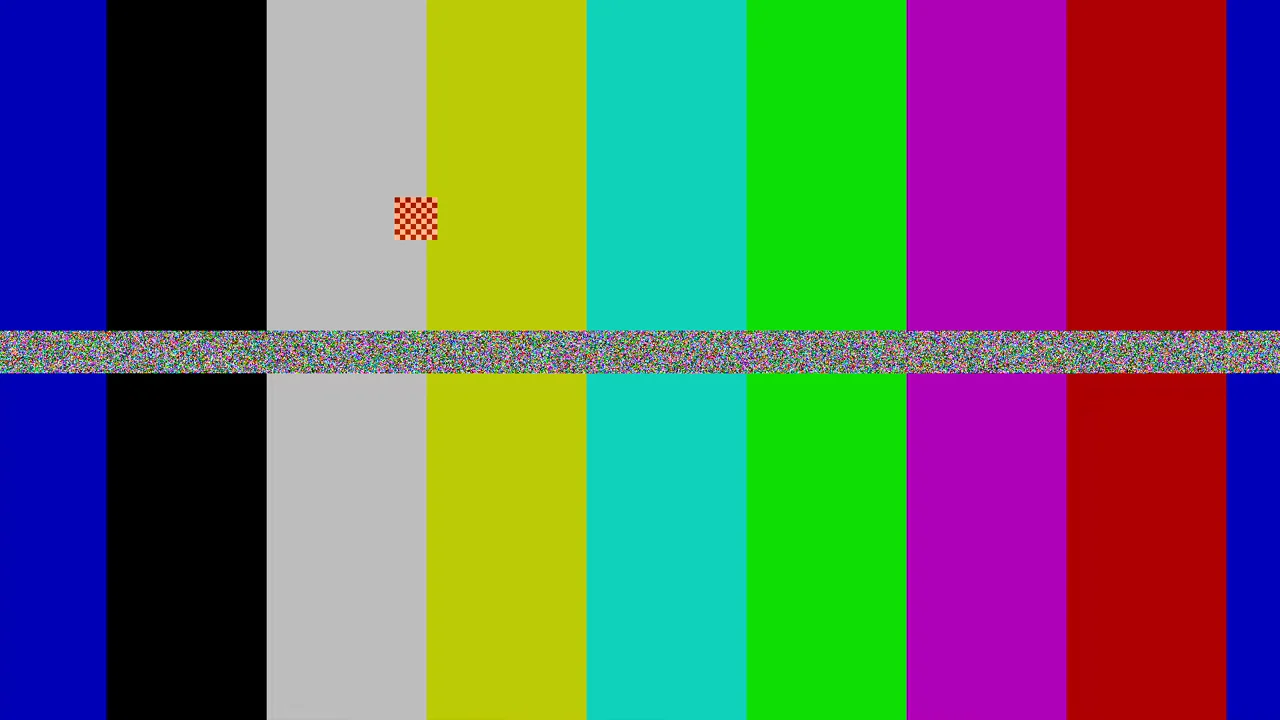
Figure 2. A frame decoded from the Nexys Baseline stream at 1080p30, QP 28. The bars expose color or packing errors, the moving checkerboard exercises inter prediction, and the noise band raises the bit demand.
Documentation
The system brief summarizes this page. The specifications hold the full interface and measurement detail.
Document
Contents
Open
H.264 video over Ethernet brief
The chain, both board results, the prebuilt demo and bundle pricing
Streaming H.264 over Ethernet from an FPGA. The blocks between a camera and a player on a PC, and what our Nexys Video and Zybo Z7-20 builds measured at 1080p30.
The streaming bundle plus the IronH264 High Profile netlist extension for your FPGA part.
Add IronVideo to either bundle for $1,500.
$30,000Per product/SKU; maintenance $5,000/yearContact Us
Every core uses the IronKernel source-available license model, the same one as the VITA 46.11 IPMC. Evaluation, research, teaching and personal use cost nothing. An Open Product ships free when its complete design sources are published and changes are offered back within 90 days. A product with private design sources needs a commercial license before it ships. Enterprise licensing for multiple products/SKUs is by quote: support@ironkernel.com. H.264 patent licensing for a shipped product is the licensee's responsibility. Single-core prices are on each core's page: IronH264, IronCapture, RTLNet, IronVideo.
Questions and answers
Which IronKernel cores make up H.264 video over Ethernet?
IronCapture receives the MIPI CSI-2 camera and writes YUYV frames to DDR. IronH264 encodes those frames to H.264 Constrained Baseline. RTLNet carries the MPEG transport stream over UDP on Ethernet. The streaming bundle licenses the three together.
What resolution and frame rate does the FPGA H.264 stream reach?
1920 × 1080 at 30 pictures per second and 1280 × 720 at 30 pictures per second. On the Zybo Z7-20, one encoder engine at 121.85 MHz delivered 30.00 pictures/s from a Pcam 5C camera at 1080p. On the Nexys Video, two engines at 90 MHz encoded 1080p30 for ten minutes with zero dropped pictures.
Does the H.264 encoder need a CPU?
Prediction, motion search, transform, quantization, entropy coding and reconstruction run in FPGA logic. A small processor (MicroBlaze V on the Nexys Video, a Cortex-A9 under Linux on the Zybo) supplies the parameter sets, packs the encoded pictures into MPEG-TS and sends them over UDP.
Which player shows the stream?
VLC and ffplay both play it. The board sends MPEG-TS over UDP to port 5004; open udp://@:5004 on the PC.
Is there a way to try it without buying a license?
Yes. The prebuilt Nexys Video bitstream on this page runs with no time limit, and evaluation use of the source costs nothing under the source-available license.
Put video on your network
Send your FPGA part, camera and target bit rate. We integrate the chain into your board design under a fixed-price contract.