← All IP coresNetlist extension to IronH264 · Timed demo
H.264 High Profile encoder for FPGA: CABAC extension for IronH264
IronH264 High Profile adds CABAC entropy coding and the 8 × 8 transform to the IronH264 encoder, for H.264 High Profile video at a lower bit rate.
It is a netlist extension to the publicly available IronH264 core (source on GitHub), not a second encoder. It plugs into each IronH264 engine and uses the same DDR buffers, registers and bitstream rings. A timed bitstream for the Nexys Video shows it running.
The Nexys Video image runs CABAC for 30 minutes after each configuration, then continues in Constrained Baseline. A Digilent Nexys Video with its power supply, two micro-USB cables (PROG and UART), an Ethernet cable to a network with DHCP, and Vivado 2026.1 with its free license.
Program. Load rtlnet_nexys_video.bit over JTAG with the Vivado Hardware Manager or the included program.ps1. The firmware is inside the bitstream.
Connect. Open the UART port at 115200 baud, 8N1. show ip prints the address the board got from DHCP.
Play. On the PC run ffplay -fflags nobuffer udp://@:5004, or open udp://@:5004 in VLC. Let UDP port 5004 through the PC firewall.
Stream. On the console: enable, camera mode 1080p30, camera pattern all 4, encoder bitrate 8000, then stream h264 <PC address> 5004.
Compare.show encoder prints the active profile and the remaining High Profile time. Run the same pattern on the Baseline demo and compare the bit rates.
High Profile timed evaluation
Prebuilt
Digilent Nexys Video, Artix-7 XC7A200T. Two IronH264 engines at 90 MHz with the CABAC netlist (4 × 4 transform).
High Profile for 30 minutes per configuration, then Constrained Baseline on the same stream.
3.4 MBZip: image, run guide, build record, licenseDownload
The package is covered by its own evaluation license (LICENSE_DEMO.md in the zip): run it, pass it on complete and unmodified at no charge, and publish measurements that name the package. It contains no source and no netlist.
Overview
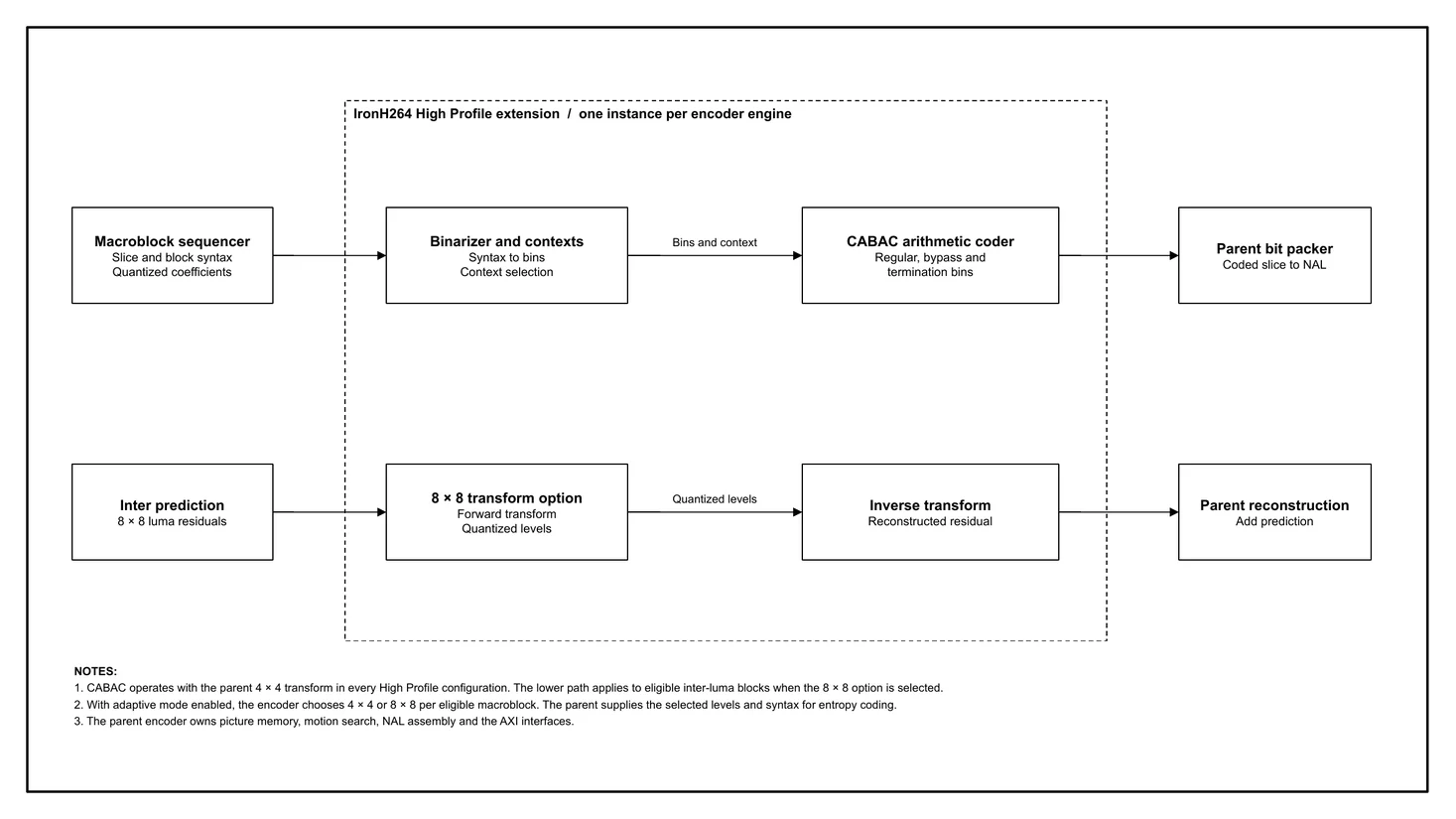
Each enabled encoder engine contains one High Profile extension. The parent IronH264 core supplies prediction, picture memory, motion search, NAL packing and the software-visible registers. The extension codes I and P slices with CABAC and, when selected, processes inter-luma residuals in 8 × 8 blocks. The stream is H.264 High Profile (profile_idc 100), progressive, 8-bit 4:2:0.
Software reads the tools present in the build before choosing a mode. A change to the effective profile forces an IDR picture, so a receiver joins cleanly and decodes through a profile transition.
Highlights
Netlist extension to IronH264. The public Baseline core stays in source form; the extension is delivered as a netlist for your FPGA part.
CABAC. Context-adaptive binary arithmetic coding for intra and predicted slices.
Inter 8 × 8 transform. Fixed, or selected per macroblock by the hardware.
Same interfaces. IronH264 AXI4-Lite registers, DDR buffers, compressed and index rings.
Clean transitions. A profile change takes effect at a picture start and forces an IDR.
Checked against three decoders. JM, OpenH264 and FFmpeg, across QCIF, 720p and 1080p cases.
At a glance
Coded stream
H.264 High Profile, profile_idc 100, 8-bit 4:2:0, I and P slices
Tool sets
CABAC; CABAC + inter 8 × 8; all tools with adaptive 4 × 4 / 8 × 8
CABAC only, XC7A200T at 90 MHz: 2,719 LUTs, 1,295 flip-flops
Source
Private repository; source license by quote
CABAC and transform tool sets
The delivered netlist declares its tool set, and software reads it from HP_STATUS before choosing a mode.
Tool set
Capability value
Operations
CABAC
0x1
Context-adaptive binary arithmetic coding for intra and predicted slices. The parent uses its 4 × 4 transform path.
CABAC + inter 8 × 8
0x3
Adds four 8 × 8 luma residual blocks per inter macroblock and their reconstruction. Software may select fixed 8 × 8.
All tools
0x7
Adds per-macroblock selection between the inter 4 × 4 and 8 × 8 paths.
Figure 1. The High Profile engine interface, from the specification.
Measured bit rate: High Profile CABAC against Baseline CAVLC
Board measurements on the Nexys Video at 1080p30, QP 28, and recorded RTL simulation results. The inputs and QP are identical across the columns.
Nexys Video board measurement
Baseline CAVLC
High Profile CABAC
Combined motion and noise pattern
27.23 Mb/s
23.83 Mb/s
Scrolling bars
0.52 Mb/s
0.25 Mb/s
Ten-minute soak
18,002 pictures, zero dropped
18,002 pictures, zero dropped
Soak bit rate
27.54 Mb/s
24.02 Mb/s
Simulation, bits in two P pictures
Baseline CAVLC
CABAC 4 × 4
CABAC fixed 8 × 8
720p scrolling bars
16,728
8,528
8,368
720p pan
9,464
7,320
7,800
1080p moving objects
2,640
3,016
3,016
The pan used fewer bits with CABAC and the 4 × 4 transform than with fixed 8 × 8, and the short 1080p objects sequence used fewer bits with Baseline. These figures describe the named synthetic scenes. In the timed image the profile transition occurred 1,799.82 seconds after configuration, and the receiver recorded 59,404 pictures over 1,980 seconds with zero drops.
Documentation
The extension's specification, and the documents that hold its board results.
H.264 Baseline vs High Profile on an FPGA. The same pictures, the same quantizer, two entropy coders. Measured bit rates on a Nexys Video, including a case where Baseline wins.
$30,000Per product/SKU; maintenance $5,000/yearContact Us
The High Profile extension is a paid feature with no free product use; the timed demonstration package is free to run and pass on. The parent IronH264 core uses the source-available license. H.264 patent licensing for a shipped product is the licensee's responsibility. Enterprise licensing for multiple products/SKUs is by quote: support@ironkernel.com.
Questions and answers
Is IronH264 High Profile a separate encoder?
No. It is a netlist extension to the publicly available IronH264 core. IronH264 supplies prediction, picture memory, motion search, NAL packing and the registers; the extension adds CABAC entropy coding and the inter 8 × 8 transform inside each engine.
How much bit rate does CABAC save?
It depends on the picture. On the Nexys Video at 1080p30 and QP 28, the combined motion and noise pattern used 23.83 Mb/s with High Profile CABAC against 27.23 Mb/s with Baseline CAVLC, and scrolling bars used 0.25 against 0.52 Mb/s. In simulation, one short 1080p sequence used fewer bits with Baseline. Evaluate with scenes that represent your product.
How is the High Profile extension delivered?
As a device-specific netlist for your FPGA part and encoder clock, with a declared tool set: CABAC, CABAC with inter 8 × 8, or all tools with adaptive selection. Source licensing is by quote.
What happens when the timed demo expires?
After 30 minutes from FPGA configuration the current picture completes, the encoder issues an IDR picture and the same stream continues in Constrained Baseline. Reload the bitstream to start another 30 minutes.
Works with
IronH264 — the publicly available Baseline core this extension requires.