A bus-mastering H.264 Constrained Baseline encoder in SystemVerilog: 720p30 and 1080p30 from frames in DDR to an Annex B stream.
IronH264 reads packed YUYV frames from DDR, reconstructs reference pictures and writes an indexed bitstream back to memory. One to four engines share the picture. It runs on AMD Artix-7 and Zynq-7000 boards, with full source, drivers and a prebuilt streaming demo.
The Nexys Video image encodes on-board test patterns with two IronH264 engines and streams the result to a PC. A Digilent Nexys Video with its power supply, two micro-USB cables (PROG and UART), an Ethernet cable to a network with DHCP, and Vivado 2026.1 with its free license.
Program. Load rtlnet_nexys_video.bit over JTAG with the Vivado Hardware Manager or the included program.ps1. The firmware is inside the bitstream.
Connect. Open the UART port at 115200 baud, 8N1. show ip prints the address the board got from DHCP.
Play. On the PC run ffplay -fflags nobuffer udp://@:5004, or open udp://@:5004 in VLC. Let UDP port 5004 through the PC firewall.
Stream. On the console: enable, camera mode 1080p30, camera pattern all 4, encoder bitrate 8000, then stream h264 <PC address> 5004.
Measure.show stream and show encoder print picture counts, bit rate and dropped pictures. stream stop ends the stream.
H.264 Baseline streaming demo
Prebuilt
Digilent Nexys Video, Artix-7 XC7A200T. Constrained Baseline, CAVLC, in-loop deblocking, two engines at 90 MHz.
720p30 and 1080p30. Constant QP or constant bit rate from the console. No time limit.
3.3 MBZip: image, run guide, build record, licenseDownload
The image loads into the FPGA only; a power cycle removes it. The zip holds the bitstream, the run guide, the build record and the license.
Overview
IronH264 is a hardware H.264 encoder for FPGA video systems. Software submits a picture and supplies its sequence and picture parameter sets. The FPGA performs prediction, motion search, transform, quantization, entropy coding and reconstruction, and software passes the compressed access unit to a recorder or a network transport.
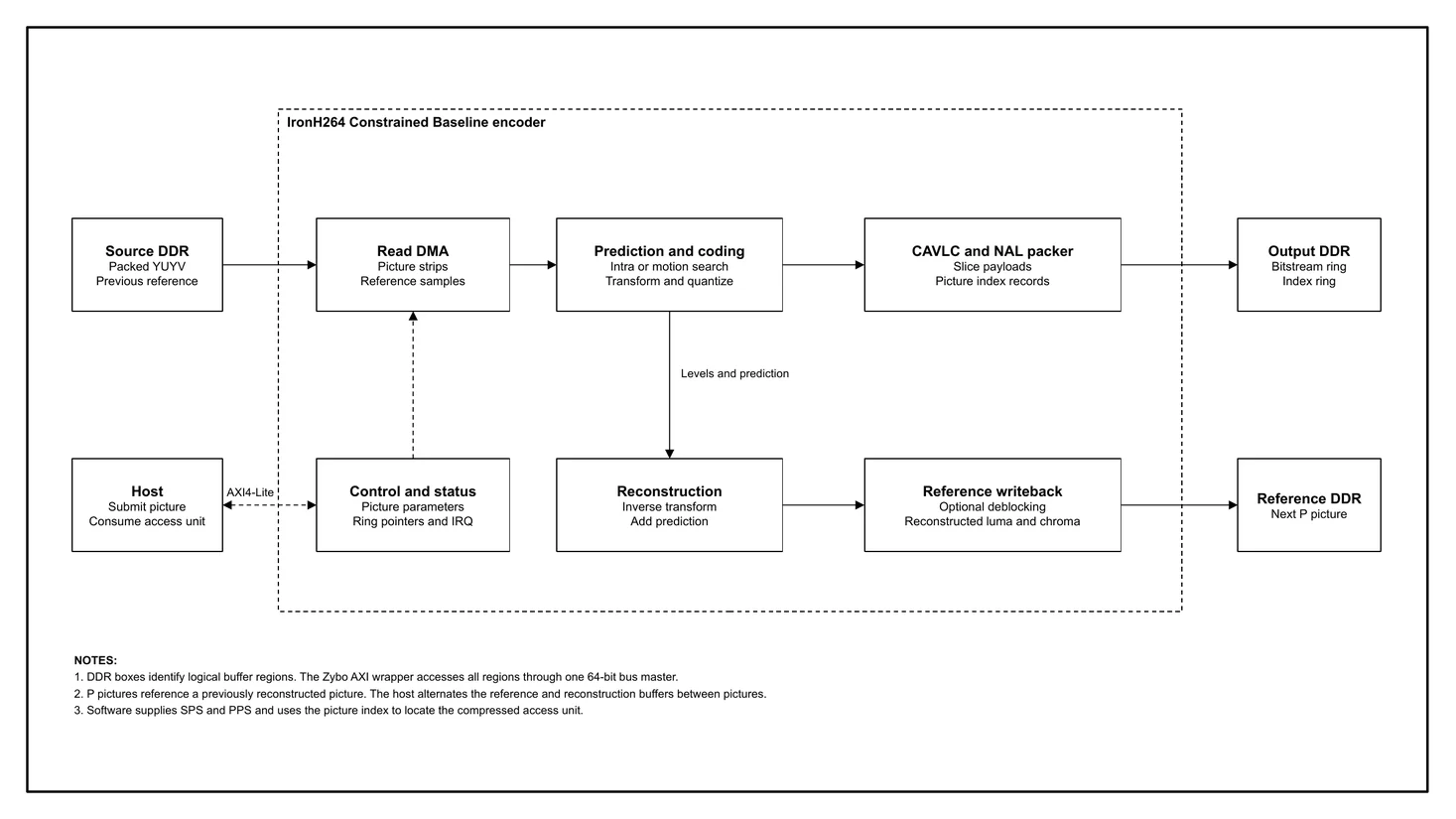
The encoder owns its memory traffic. A read DMA fetches strips of macroblocks from the source frame, the reconstruction path writes the reference picture a decoder will reproduce, and the packer assembles slice syntax and NAL units into a compressed ring with a separate index of byte ranges. Ring pressure stalls the producer, so unread data is protected.
IronH264 is the standard, publicly available core. IronH264 High Profile is a netlist extension that plugs into it and adds CABAC and the 8 × 8 transform.
Highlights
Constrained Baseline. Progressive 8-bit 4:2:0, I/IDR and P pictures, CAVLC, optional in-loop deblocking filter, I_PCM fallback.
720p and 1080p. 80 × 45 and 120 × 68 coded macroblocks.
One to four engines. The engines partition the picture into bands for a higher picture rate.
Bus master. AXI4 memory interface at 64 or 128 bits; no CPU copies pixels.
Rate control. Constant QP or constant bit rate; 7.99–8.02 Mb/s measured at an 8 Mb/s target.
Checked against three decoders. JM, OpenH264 and FFmpeg decode the stream and match the encoder's reconstruction.
Drivers included. Bare-metal control API and a Linux driver with DMA-BUF input.
High Profile ready. The register file carries the High Profile controls, so the extension drops in.
At a glance
Standard
ITU-T H.264 Constrained Baseline
Input
Packed 8-bit YUYV 4:2:2 in DDR
Output
Annex B NAL units, slice and picture index records
Resolutions
1280 × 720, 1920 × 1080
Memory bus
AXI4 master, 64 or 128 bits
Control
32-bit AXI4-Lite, interrupt
Language
SystemVerilog, Verilog top
Proven on
Artix-7 XC7A200T, Zynq-7000 XC7Z020
How the H.264 encoder works
The engine forms residuals, transforms and quantizes them, then codes the coefficients with CAVLC. The reconstruction path inverse-quantizes and inverse-transforms the retained levels and adds the prediction, so the reference matches what a decoder produces.
Area
Features
Input and prediction
A read DMA fetches strips of macroblocks from packed DDR rows. Luma passes through; chroma is averaged vertically to form 4:2:0. Intra prediction uses the current picture. For P pictures, motion search reads the previous reconstructed picture.
Coding and reconstruction
Residual, transform, quantization and CAVLC. The optional in-loop deblocking filter operates on the reconstruction. I_PCM provides an exact-sample macroblock mode and a fallback for difficult blocks.
Stream assembly
The packer writes slice syntax and NAL units into the compressed ring. A separate index describes the byte ranges, so software assembles access units and marks IDR boundaries.
Parallelism
One to four engines partition the picture into bands. The slice count is a multiple of the engine count.
Registers
Discovery (ID, version, capabilities), picture configuration, buffer addresses, ring pointers, picture and cycle counters, interrupt status and enables, deblocking controls.
Linux reference
On the Zybo Z7-20 an application passes an IronCapture DMA-BUF to /dev/ironh264; the driver starts the engine and returns the compressed length and keyframe flag.
Figure 1. IronH264 memory and encoding data path, from the specification.
Measured H.264 encoder results on Artix-7 and Zynq-7000
Recorded board measurements from the IronH264 and RTLNet specifications.
Test
Result
Zybo Z7-20, Pcam 5C camera, 1080p, one engine at 121.85 MHz
1,800 of 1,800 pictures encoded and decoded; 30.00 pictures/s; 20.45 Mb/s H.264, 21.02 Mb/s MPEG-TS; zero continuity errors; median picture interval 33.333 ms
Same, one engine at 90 MHz
1,800 of 1,800 pictures; 23.50 pictures/s; 14.63 Mb/s H.264
Nexys Video, 1080p30, two engines at 90 MHz, QP 28, 10-minute soak
18,002 pictures, zero dropped, 27.54 Mb/s, minimum measured PSNR 44.28 dB
Nexys Video, 1080p30 rate control
7.99–8.02 Mb/s at an 8 Mb/s target; 15.99–16.01 Mb/s at a 16 Mb/s target
Nexys Video, 720p30, QP 28
18.17 Mb/s, zero pictures dropped
Nexys Video routed image (whole design)
94,557 LUTs, 89,000 flip-flops, 292.5 block RAM tiles, 84 DSPs, +0.156 ns setup slack. The totals include the processor, DDR, Ethernet and two encoder engines.
Bit rates are averages for the measured scene and settings. Picture rate depends on content, engine count, encoder clock, QP and memory service.
Documentation
The specification is the interface reference. The board documents show the encoder inside complete systems.
Document
Contents
Open
IronH264 specification
Data path, DDR layout and ring protocol, register interface, Linux reference, camera measurements, verification
Streaming H.264 over Ethernet from an FPGA. The blocks between a camera and a player on a PC, and what our Nexys Video and Zybo Z7-20 builds measured at 1080p30.
Every core uses the IronKernel source-available license model, the same one as the VITA 46.11 IPMC. Evaluation, research, teaching and personal use cost nothing. An Open Product ships free when its complete design sources are published and changes are offered back within 90 days. A product with private design sources needs a commercial license before it ships. Enterprise licensing for multiple products/SKUs is by quote: support@ironkernel.com. H.264 patent licensing for a shipped product is the licensee's responsibility. The source is public on GitHub. Public access alone does not grant unrestricted commercial use: a product with private design sources needs the commercial license.
Questions and answers
Which H.264 profile does IronH264 produce?
Constrained Baseline: progressive 8-bit 4:2:0 with I/IDR and P pictures and CAVLC entropy coding, with an optional in-loop deblocking filter. High Profile with CABAC is a separate netlist extension, IronH264 High Profile.
What resolutions and frame rates does the encoder reach?
1280 × 720 and 1920 × 1080. One engine at 121.85 MHz on a Zynq-7000 delivered 30.00 pictures/s at 1080p from a camera. Two engines at 90 MHz on an Artix-7 XC7A200T encoded 1080p30 for ten minutes with zero dropped pictures. Picture rate depends on content, engine count, encoder clock and QP.
How does the encoder connect to the rest of the design?
It is a bus master. It reads packed YUYV frames from DDR through AXI4 (64- or 128-bit), writes the compressed stream and an index back to memory rings, and is controlled through a 32-bit AXI4-Lite register file with an interrupt.
Is the source code included?
Yes. IronH264 is delivered as SystemVerilog source with testbenches, a bare-metal driver, a Linux driver and decoder check tools that use JM, OpenH264 and FFmpeg.