RTLNet handles ARP, ping, DHCP and UDP in FPGA logic. Its processor path adds TCP services, hardware checksum offload and a configurable firewall.
An Ethernet MAC, protocol cores and a packet classifier in SystemVerilog, with C drivers and firmware. It measures 942 Mb/s of UDP on a 1 Gb/s link, and runs on the Digilent Nexys Video and Arty A7-100T with prebuilt bitstreams.
Each image is a complete RTLNet endpoint with a serial console. You need the board, its power supply and USB cables, an Ethernet cable to a network with DHCP, and Vivado 2026.1 with its free license.
Program. Load the .bit over JTAG with the Vivado Hardware Manager or the included program.ps1. The firmware is inside the bitstream.
Connect. Open the UART port at 115200 baud, 8N1. The console shows the negotiated link; show ip prints the DHCP address.
Ping. Ping the board from the PC. The reply comes from FPGA logic.
Measure. Run iperf 2 against the board for UDP and TCP in both directions, and try the UDP echo.
Flood. Enable the firewall from the console (classifier firewall enable) and watch the drop counters under a flood.
Nexys Video, 10/100/1000 Mb/s
Prebuilt
Artix-7 XC7A200T, Realtek RTL8211E PHY, RGMII. Hardware ARP, ping, DHCP and UDP; TCP echo and iperf 2 on a 100 MHz MicroBlaze V.
1.1 MBZip: image, run guide, build record, licenseDownload
The images load into the FPGA only; a power cycle removes them.
Overview
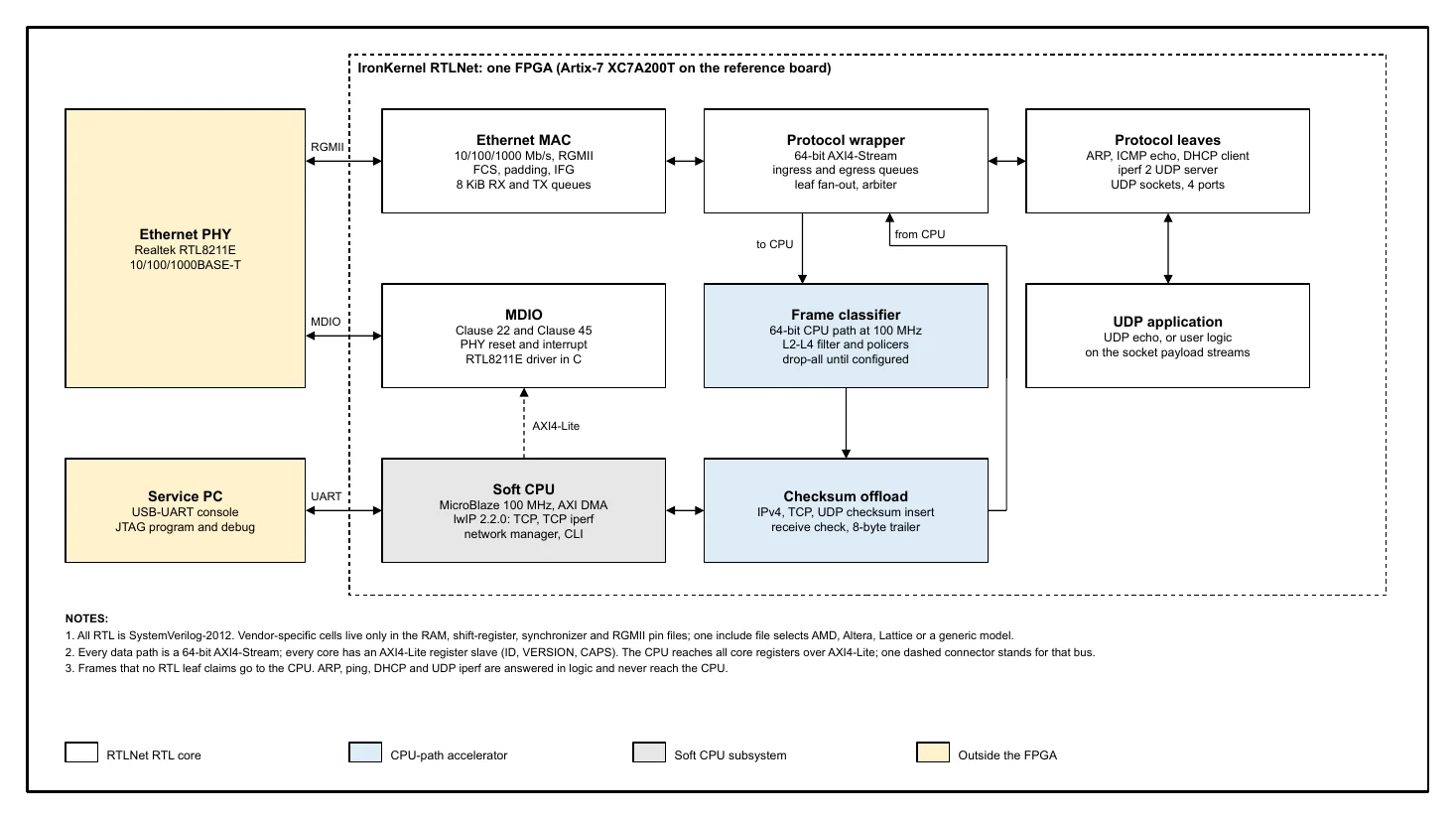
An FPGA application exchanges UDP payloads through AXI4-Stream. Protocol logic receives, classifies and answers traffic independently of firmware. Frames that need a software service reach lwIP through a protected DMA path, and a serial console gives the operator link state, address configuration, service counters and classifier rules.
The MAC client interface is a 64-bit AXI4-Stream. A bound UDP socket delivers each datagram as two metadata beats followed by 0 to 1,472 payload bytes, and builds the Ethernet, IPv4 and UDP headers on transmit.
Highlights
UDP in logic. ARP, ICMP echo, DHCP and UDP sockets with no CPU in the data path.
942 Mb/s measured. Hardware UDP on a 1 Gb/s link with zero reported loss.
TCP when needed. lwIP on a MicroBlaze V with hardware checksum offload: 337.7 Mb/s receive, 280.3 Mb/s transmit.
Firewall and policers. Default-deny allow list and four policers in front of the processor.
10 Gb/s classifier. Rated for lossless inspection of a 10 Gb/s link at 156.25 MHz, with your MAC and PCS.
RGMII and MII MACs. 10/100/1000 Mb/s, with MDIO Clause 22 and 45.
Vendor-neutral SystemVerilog. Device primitives are selected in one technology header; AMD is the default.
Drivers and firmware. C11 drivers, MicroBlaze V firmware with a command line, and host tests.
Traffic claimed in hardware stays on the hardware path. Unclaimed frames are candidates for the CPU, and pass the classifier first.
Function
Behavior
Ethernet and PHY
The MAC handles frame checks, padding and the inter-frame gap. MDIO provides PHY discovery, link negotiation and diagnostics.
Receive dispatch
The wrapper checks the destination MAC and presents each frame to the protocol blocks.
Hardware UDP
Bound sockets expose payload streams with metadata. UDP echo and the iperf 2 server exercise receive and transmit independently of the CPU.
CPU protection
L2–L4 classification, policers and a configurable allow list govern traffic reaching the CPU. The optional default-deny firewall admits ARP and enabled TCP services.
Software TCP
MicroBlaze V runs lwIP TCP echo and iperf 2. Hardware patches outbound checksums and verifies received traffic.
Classifier match engines
Field tables (MAC, EtherType, VLAN, IPv4 address, port), an IPv4 tuple ACL, and positional byte rules within a 64-byte prefix.
Figure 1. The Nexys Video data path, from the specification. The Arty design connects an MII MAC to the same protocol and application interfaces.
Measured FPGA Ethernet throughput
A wired PC and unmanaged switch connected each board to the iperf 2 peer. Values are Mb/s of application traffic from the released Ethernet-only images; TCP figures are means of three runs.
Board and link
Firewall
UDP PC → board
UDP board → PC
TCP PC → board
TCP board → PC
Nexys Video, 1,000 Mb/s
On
942.0
944.0
337.7
280.3
Nexys Video, 1,000 Mb/s
Off
943.0
944.0
336.0
281.0
Nexys Video, 100 Mb/s
On
93.9
94.4
94.5
94.9
Arty A7-100T, 100 Mb/s
Off
94.0
94.4
94.5
94.9
Measurement
Result
Latency, Nexys Video at 1 Gb/s, firewall on
64-byte UDP echo 0.166 ms round trip (p99 0.213 ms); TCP echo 0.198 ms (p99 0.234 ms), through the switch and host.
Flood protection
At 100,000 offered flood frames/s the classifier dropped all 1,000,000 flood frames. Both boards passed 21 of 21 firewall checks.
10 Gb/s classifier
200 back-to-back minimum frames in 1,600 beats; closed at 156.25 MHz on XC7A200T-1 with +1.515 ns setup slack.
Resources, routed Ethernet image
Nexys Video: 23,891 LUTs, 33,968 flip-flops, 228.5 block RAM tiles, 6 DSPs. Arty A7-100T: 24,981 LUTs, 36,059 flip-flops, 105.5 block RAM tiles, 6 DSPs. The totals include the processor, memory, DMA and classifier.
UDP used the 90% offered-load setting. The gigabit firewall-off run reported 20 lost datagrams from board to PC; both firewall-on gigabit runs reported zero loss. The 10 Gb/s rating applies to the classifier and the 64-bit stream; the released MACs reach 1 Gb/s (RGMII) and 100 Mb/s (MII).
Documentation
The specification covers every core, both Ethernet images and the Nexys media images.
Document
Contents
Open
RTLNet specification
Ethernet MAC, protocol cores, classifier and firewall, checksum offload, throughput, resources, DDR and frame cores, H.264 results
Gigabit UDP from an FPGA. Where the bits go on a 1 Gb/s link, why UDP belongs in logic, and the measured gap between hardware UDP and software TCP on the same board.
Three steps, each a one-time fee in USD per product/SKU with full source. No royalties and no per-unit fees. A lower step is credited in full toward a higher one.
RTLNet UDP
The hardware endpoint: RGMII and MII MAC, ARP, ping, DHCP and UDP sockets on AXI4-Stream.
For an FPGA instrument or data source that sends and receives UDP.
Evaluation costs nothing: run the prebuilt demos, read the source, simulate and build prototypes that are not sold. Every core uses the IronKernel source-available license model, the same one as the VITA 46.11 IPMC. Evaluation, research, teaching and personal use cost nothing. An Open Product ships free when its complete design sources are published and changes are offered back within 90 days. A product with private design sources needs a commercial license before it ships. Enterprise licensing for multiple products/SKUs is by quote: support@ironkernel.com. lwIP files keep their BSD license. The source is public on GitHub. Public access alone does not grant unrestricted commercial use: a product with private design sources needs the commercial license.
Questions and answers
Does RTLNet need a CPU?
No for UDP. ARP, ping, DHCP and UDP sockets run in FPGA logic, and an application exchanges UDP payloads through AXI4-Stream. The optional processor path adds TCP services through lwIP on a MicroBlaze V, with hardware checksum offload and a firewall in front of the CPU.
How fast is the FPGA UDP stack?
On the Nexys Video at 1 Gb/s with the firewall enabled, hardware UDP delivered 942 Mb/s from PC to board and 944 Mb/s from board to PC with zero reported loss. A 64-byte UDP echo averaged 0.166 ms round trip.
Which PHY interfaces and speeds are supported?
RGMII at 10, 100 and 1,000 Mb/s and MII at 10 and 100 Mb/s, with MDIO Clause 22 and Clause 45 management. The classifier and 64-bit stream are rated for 10 Gb/s with a MAC and PCS you supply; RTLNet does not include a 10 Gb/s MAC.
What does the firewall protect?
The processor. The classifier inspects whole frames before DMA or lwIP spends time on them, with a default-deny allow list and four policers. In the recorded test at 100,000 offered flood frames per second it dropped all 1,000,000 flood frames.