Evaluation
FreeEvaluation, development, research, teaching and personal use, including prototypes that are not sold.
Open Products ship free when their complete design sources are published.
$0Free public updates
GitHub

IronVideo is a bus-mastering video core that scans a framebuffer out of DDR to an HDMI or LCD display, with low CPU overhead.
The CPU sets the framebuffer address, format and display timing over AXI4-Lite. IronVideo generates the DDR reads and the raster. It displays 720p60 on the Nexys Video and 1080p60 on the Zybo Z7-20, under bare metal, U-Boot and Linux DRM.
A Linux application software-rasterizes a rotating 3 × 3 cube into the XRGB8888 framebuffer in DDR, and IronVideo scans it out to the monitor at 1920 × 1080 and 60 Hz.
1080p60 on the Zybo Z7-20 is an engineering mode: the 742.5 MHz serializer clock exceeds the speed-grade −1 clock-network rating of the XC7Z020, and the measurements apply to the tested board and display. 720p60 is the rated mode on both reference boards.
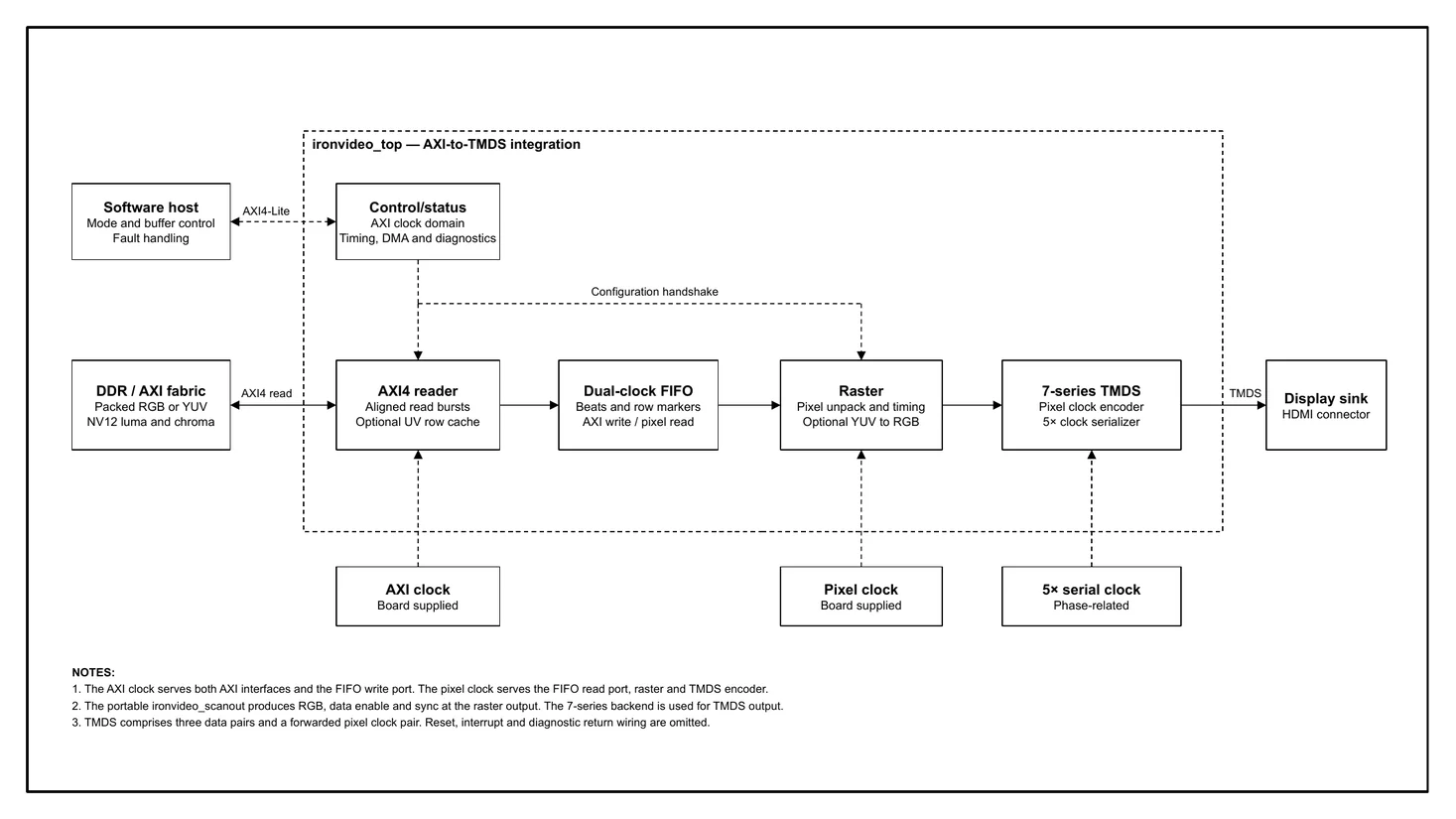
IronVideo reads a framebuffer from DDR and produces registered RGB, data enable, horizontal sync and vertical sync. A dual-clock FIFO separates the DDR reads from the pixel raster. The portable SystemVerilog scanout feeds an external transmitter or an LCD; the public top joins it with the included 7-series TMDS serializer for an HDMI connector.
Firmware, U-Boot and Linux use the same register map and the same portable driver. Sticky fault flags, raster snapshots and row-timing counters show whether memory keeps up with the display.
| Formats | XRGB8888, RGB565, YUYV, NV12 |
|---|---|
| Memory bus | AXI4 read master, 32/64/128 bits |
| Pixel FIFO | 16 to 128 KiB |
| Control | 32-bit AXI4-Lite, interrupt |
| Outputs | 24-bit RGB with DE/HS/VS; TMDS on 7-series |
| Software | Bare metal, U-Boot, Linux DRM/KMS |
| Language | SystemVerilog, Verilog top |
| Proven on | Nexys Video (XC7A200T), Zybo Z7-20 (XC7Z020) |
Control and DDR service use the AXI clock. The FIFO separates DDR reads from the pixel raster. The 7-series transmitter uses pixel and serializer clocks.
| Module | Responsibility |
|---|---|
ironvideo_top | Public Verilog/Vivado top. Exposes the AXI interfaces, interrupt and four TMDS pairs. |
ironvideo_scanout | Portable top. Implements register transactions, mode validation, fault state and cross-domain commands. |
ironvideo_reader | Reserves a complete active row, schedules bursts and attaches line and frame markers. |
ironvideo_fifo | Dual-clock RAM that bridges the AXI and pixel domains. |
ironvideo_raster | Advances timing and aligns FIFO data to active pixels. |
ironvideo_tmds_7series | Three encoders, three serialized data lanes and a forwarded clock lane. |
Recorded board measurements from the specification.
| Board and mode | Result |
|---|---|
| Nexys Video, 720p60, XRGB8888, RGB565, YUYV and NV12 | 60.000 frames/s over 360 frames in each format, with zero underruns or errors. |
| Zybo Z7-20, 720p60 | 3,600 frames with zero underruns. |
| Zybo Z7-20, 1080p60 XRGB8888 (engineering mode) | 4,204 frames in 70.07 s with zero underruns, AXI read errors or faults. Peak DDR fetch 1.158 GB/s. |
| Zybo Z7-20, 1080p60 with camera capture running | 300 of 300 camera frames captured at 1080p30 while the display recorded zero underruns. |
The specification is the interface reference. The board briefs show the display inside complete Linux systems.
| Document | Contents | Open |
|---|---|---|
| IronVideo specification | Architecture, FPGA compatibility, DDR read master, registers, drivers, reference results | |
| Zybo Z7-20 board brief | 1080p60 HDMI console, the cube demo, camera and H.264 under IronForge Linux | |
| Nexys Video board brief | 720p60 HDMI console and games under IronForge Linux on MicroBlaze | |
| Source repository | SystemVerilog source, testbenches, the shared driver and the Nexys reference design | GitHub |
| Article | 1080p60 HDMI from a Zynq-7020. The clocks, the DDR traffic and the measurements behind a 1080p60 console on a Zybo Z7-20, and why we call it an engineering mode. | Read |
One-time fees in USD per product/SKU. No royalties and no per-unit fees.
Evaluation, development, research, teaching and personal use, including prototypes that are not sold.
Open Products ship free when their complete design sources are published.
Ship IronVideo in a product whose design sources stay private. Full source, testbenches and the shared driver.
Maintenance is free with no annual fee.
Add IronVideo to an H.264 video over Ethernet bundle for local display next to the stream.
Every core uses the IronKernel source-available license model, the same one as the VITA 46.11 IPMC. Evaluation, research, teaching and personal use cost nothing. An Open Product ships free when its complete design sources are published and changes are offered back within 90 days. A product with private design sources needs a commercial license before it ships. Enterprise licensing for multiple products/SKUs is by quote: support@ironkernel.com. The Linux kernel driver is GPL-2.0-only. The source is public on GitHub. Public access alone does not grant unrestricted commercial use: a product with private design sources needs the commercial license.
Timing is set by software, so the core accepts progressive modes within its register and FIFO limits. The Nexys Video reference displays 1280 × 720 at 60 Hz in all four framebuffer formats. The Zybo Z7-20 reference displays 1920 × 1080 at 60 Hz as an engineering mode on the tested board.
XRGB8888, RGB565, YUYV and NV12. A build enables any subset.
Yes. One portable driver serves bare metal, U-Boot and a Linux atomic DRM/KMS driver, so the display is live from the boot loader through to the Linux console and applications.
The included TMDS transmitter targets AMD 7-series devices (Artix-7 and Zynq-7000 are demonstrated). The portable scanout produces parallel RGB with data enable and sync for an external transmitter or an LCD; other AMD and Altera families are available for project integration.
Send your FPGA part, display or LCD timing and memory interface. We integrate the scanout and the Linux driver under a fixed-price contract.